

The Rabbit Re‑Eating Ritual — Do They Really Eat Their Own Poo, and Why on Earth Would They Do That?
Episode 62

* (A tale of fine dining, fermented fibre, and one species that has turned “recycling” into a lifestyle)
* Warning: This article may cause surprise, fascination, and the urge to apologise to rabbits for every time you judged their dietary choices.
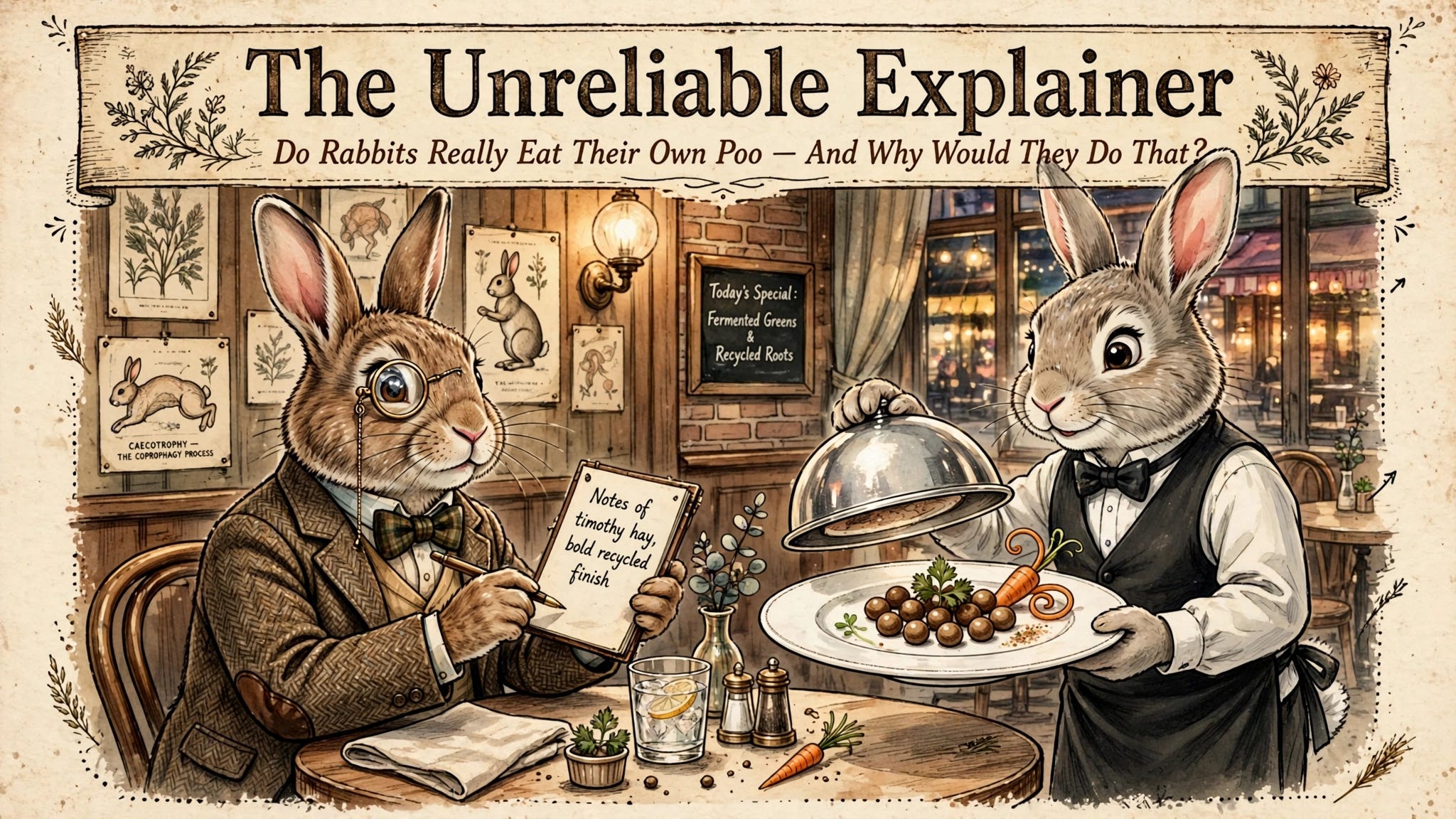
Look at this delightfully absurd restaurant tableau. A scholarly rabbit in tweed examines a notepad with the seriousness of a food critic at a Michelin‑star venue. A waiter rabbit lifts a silver dome to reveal a plate of… well… pellets. Garnished. Presented. Celebrated. The chalkboard announces “Fermented Greens & Recycled Roots” like it’s the special of the day. The framed diagram on the wall hints at something deeper — a biological process masquerading as haute cuisine.
This is not a joke. This is caecotrophy — and rabbits take it very seriously.
The “Official” Story
(According to veterinarians and biologists who have long accepted that rabbits are quirky geniuses)
Rabbits produce two types of droppings:
Hard pellets — the ones you see on the ground.
Caecotrophs — soft, nutrient‑rich clusters produced in the caecum.
Rabbits must eat caecotrophs to stay healthy.
Caecotrophs contain essential vitamins, fatty acids, and proteins that weren’t absorbed the first time.
This process is not “coprophagy” in the gross sense — it’s a biological adaptation for extracting maximum nutrition from fibrous plants.
Bless them. They’ve been explaining this for decades while humans giggle.
The Real Story
(The one that actually makes sense, impossibly)
This Isn’t Eating Poo — It’s a Second Pass Through the Kitchen.
Caecotrophs are not waste. They’re unfinished meals. Rabbits outsource part of their digestion to a fermentation chamber (the caecum), then retrieve the results like a chef checking a slow‑cooked stew.The Waiter Isn’t Serving Food — He’s Delivering Science.
The silver dome isn’t dramatic flair. It’s a metaphor for the rabbit’s biological elegance. What looks strange to us is simply nutritional optimisation to them.The Critic Rabbit Isn’t Pretentious — He’s Accurate.
“Notes of timothy hay, bold recycled finish.” That’s not satire. That’s a rabbit’s genuine flavour profile. Caecotrophs are packed with beneficial microbes and nutrients — practically a probiotic superfood.The Restaurant Isn’t a Joke — It’s a Lesson.
The framed diagram and chalkboard specials remind us that nature often hides brilliance behind behaviours humans find odd. Rabbits aren’t weird. They’re efficient.
The Why and Wherefore
(A lesson in connection)
Caecotrophy teaches us that survival strategies come in many forms — some elegant, some surprising, some downright adorable, some, well, better left to others. Rabbits thrive on low‑quality vegetation because they’ve evolved a system that extracts every possible nutrient. What looks strange is actually genius.
And perhaps that’s the real truth. Nature doesn’t waste. It reinvents.
Things To Ponder
(Next time you see a rabbit hop by)
Is “gross” just a human label for “effective”
What other animals have secret digestive superpowers
Are rabbits the true pioneers of sustainability
If humans had caecotrophy, would breakfast be optional
Should rabbits be considered tiny, fluffy biochemists
Tune in next time, for Episode 63, where we step into the ancient world of omens, augurs, sacred chickens, and politicians who refused to make a decision without consulting the sky:
“Roman Augury: How Birds, Entrails, and Divine Signs Guided an Empire.”
The damned things fluoresce at night when mineral searching in the UK.