

Fractals — Infinite Detail Stuffed Into a Finite World
Episode 55

* (A coastline, a ruler, and one professor’s slow descent into mathematical madness)
* Warning: This article may cause recursive thinking, zoom‑induced vertigo, and the urge to measure random objects for “self‑similarity.”
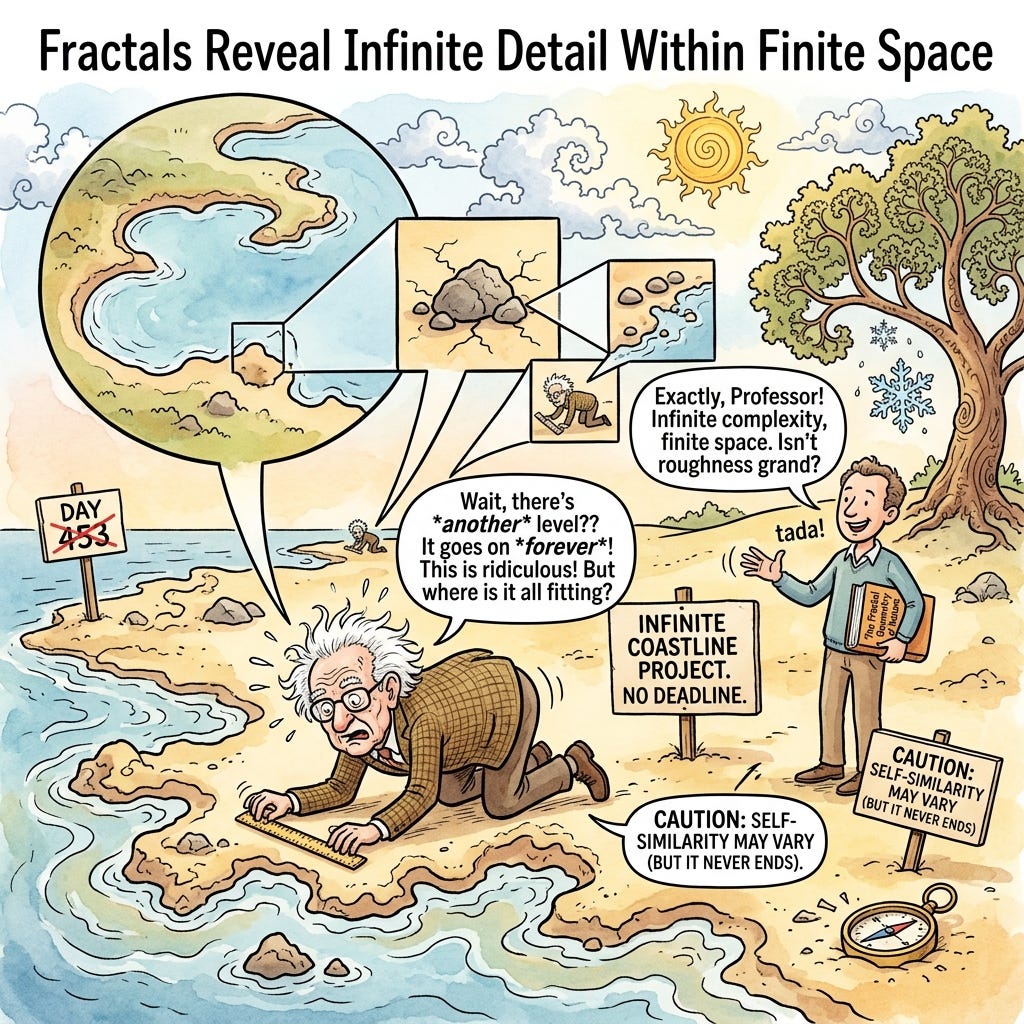
Look at this chaotic beach scene. At first glance, it’s innocent: a coastline, a ruler, a professor kneeling in the sand with the haunted expression of someone who has just realised their weekend is gone. But then the zoom‑ins begin. Each rock reveals smaller rocks. Each grain of sand reveals smaller grains. The coastline refuses to end. A cheerful assistant waves a clipboard labelled “INFINITE COASTLINE PROJECT. NO DEADLINE,” which is the mathematical equivalent of a threat. Signs warn of “self‑similarity” like it’s a dangerous rip current.
This is not a beach. This is a fractal ambush.
The “Official” Story
(According to mathematicians who have stared too long into the Mandelbrot abyss)
A fractal is a pattern that repeats at different scales — “self‑similarity.”
Fractals can have infinite detail even though they occupy finite space.
Natural examples include coastlines, ferns, snowflakes, lightning, and broccoli.
Benoît Mandelbrot formalised fractal geometry in the 20th century, showing that nature’s “roughness” follows mathematical rules.
Euclidean geometry (lines, circles, squares) simply can’t describe this kind of complexity.
Bless them. They tried to measure the coastline and accidentally reinvented infinity.
The Real Story
(The one that actually makes sense, impossibly)
The Coastline Isn’t Long — It’s Disobedient.
Look at the professor’s face. That’s the expression of someone who has realised the coastline is actively trolling them. Every time they measure a segment, the coastline reveals a smaller, more complicated segment. It’s like trying to fold a fitted sheet made of chaos.The Zoom‑Ins Aren’t Illustrations — They’re Threats.
Each magnified section of the coastline is nature whispering, “Oh, you thought that was the end? Adorable.” The coastline contains infinite sass compressed into a finite beach.The Assistant Isn’t Helping — They’re Recruiting.
The clipboard‑wielding assistant is far too cheerful. That’s because they’ve already accepted the truth: fractals are not measured; they consume the measurer. The “No Deadline” note is not encouragement. It’s a prophecy.The Beach Signs Aren’t Warnings — They’re Disclaimers.
“Self‑similarity may vary (but it never ends).”
Translation: “You will never finish this. Bring snacks.”
The Why and Wherefore
(A lesson in connection)
Fractals remind us that the world is far more intricate than it appears. What looks simple from afar becomes endlessly complex up close. Nature hides infinity inside the ordinary — a coastline, a leaf, a cloud. Mandelbrot didn’t just give us a new branch of mathematics; he gave us a new way to see the world: not as smooth, simple shapes, but as wild, recursive, beautifully rough structures.
And perhaps that’s the real truth: complexity isn’t the exception in nature — it’s the rule.
Things To Ponder
(Next time you walk along a beach)
If a coastline has infinite detail, does a sandcastle contain universes?
Are fractals nature’s way of showing off?
How many zoom‑ins does it take before you start questioning reality?
Is infinity big, or just busy?
If you measured your own life closely enough, would it also be self‑similar?
Tune in next time, for Episode 56, where we crack our knuckles, crack a myth, and absolutely do not crack our joints permanently:
“Does Cracking Your Knuckles Cause Arthritis?”
To see the world in a grain of sand…
love it! :-))